




















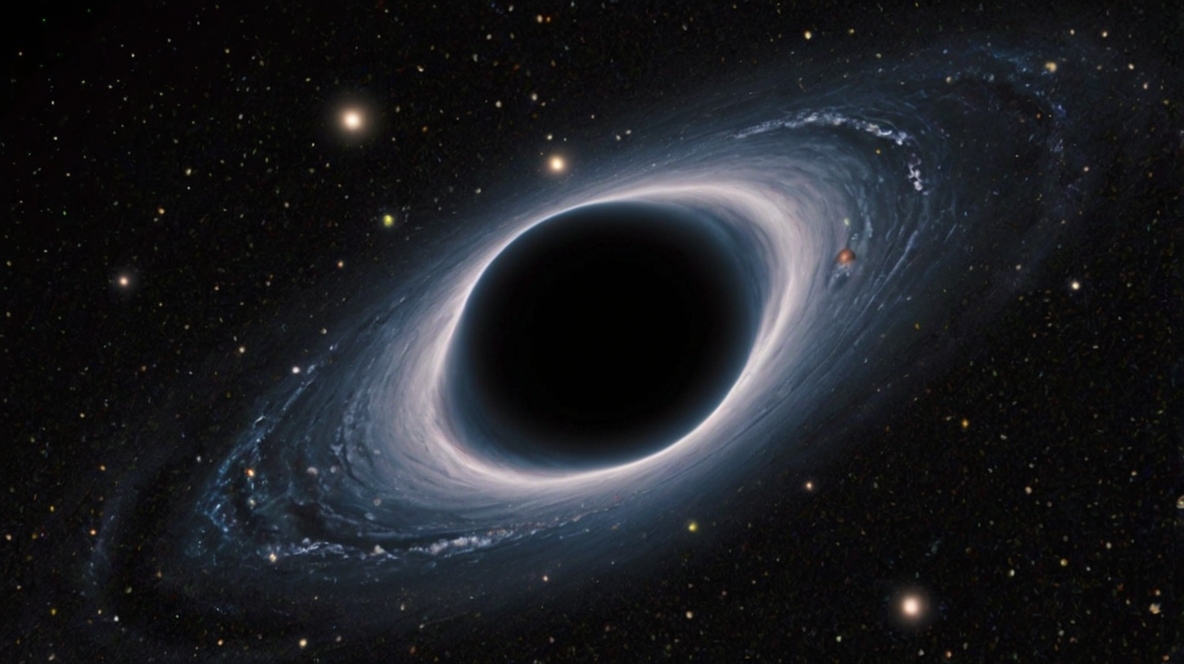
The Physics of Black Holes have long fascinated scientists and space enthusiasts alike. As one of the most mysterious objects in the universe, they hold secrets about the fabric of space, time, and the very nature of reality itself. This article explores the physics behind black holes, how they form, and their significance in space science, cosmology, and astrophysics.
What is a Black Hole?
At its most basic definition, a black hole is a region in space where the gravitational pull is so strong that not even light can escape. This happens when a massive star dies and collapses under its own gravity. The star’s core compresses into a point of infinite density, known as a singularity, and creates a gravitational field powerful enough to warp space and time.
How Do Black Holes Form?
Black holes primarily form in two ways:
- Stellar Collapse: When a star several times larger than the Sun runs out of fuel, it can no longer counteract the force of its own gravity. The outer layers explode in a supernova, while the core collapses into a black hole.
- Supermassive Black Holes: Found at the center of galaxies, including our own Milky Way, these black holes contain millions to billions of solar masses. Their origin remains a subject of intense study in astrophysics, but they are believed to have formed early in the universe’s history, growing by absorbing matter and merging with other black holes.
The Event Horizon: A Point of No Return
A black hole’s boundary is called the event horizon. Once something crosses this threshold, it is impossible to escape. The event horizon is significant in astrophysics because it marks the point where all known physical laws begin to break down. Beyond this region, the concepts of space and time as we understand them cease to function.
Understanding Singularity
At the heart of a black hole lies the singularity—a point of infinite density and zero volume. General relativity, the theory proposed by Albert Einstein, predicts the existence of singularities, but the laws of physics cannot fully explain what happens inside. This is where quantum mechanics and space science collide, as researchers seek to unify these two fields to develop a theory of quantum gravity.
The Role of Black Holes in Cosmology
Black holes are more than just cosmic vacuums; they play a significant role in the structure and evolution of the universe. Here’s how:
- Galactic Evolution: Supermassive black holes are believed to influence the formation and growth of galaxies. The immense gravitational forces at their centers may regulate star formation, control the distribution of matter, and drive galaxy mergers.
- Gravitational Waves: When black holes collide, they release ripples in space-time known as gravitational waves. These waves, first detected in 2015, are a breakthrough in space science and provide a new way to observe cosmic events.
- Time Dilation: Near a black hole, time moves more slowly due to the extreme warping of space-time. This phenomenon, predicted by Einstein’s theory of relativity, has been proven through various astrophysical observations and remains a crucial concept in cosmology.
The Search for New Physics
The study of black holes offers exciting opportunities to discover new laws of physics. For example, Hawking radiation, proposed by physicist Stephen Hawking, suggests that black holes may emit tiny amounts of radiation over time, leading them to eventually evaporate. This idea challenges conventional understanding of thermodynamics and quantum mechanics, opening the door to a deeper understanding of the universe.
Exploring the Unknown
Despite decades of research, black holes remain one of the greatest enigmas of space science. From their event horizons to their role in shaping galaxies, they offer valuable insights into the fundamental workings of the cosmos. As astrophysicists continue to study these cosmic giants, we may be on the verge of unlocking some of the universe’s deepest secrets.