




















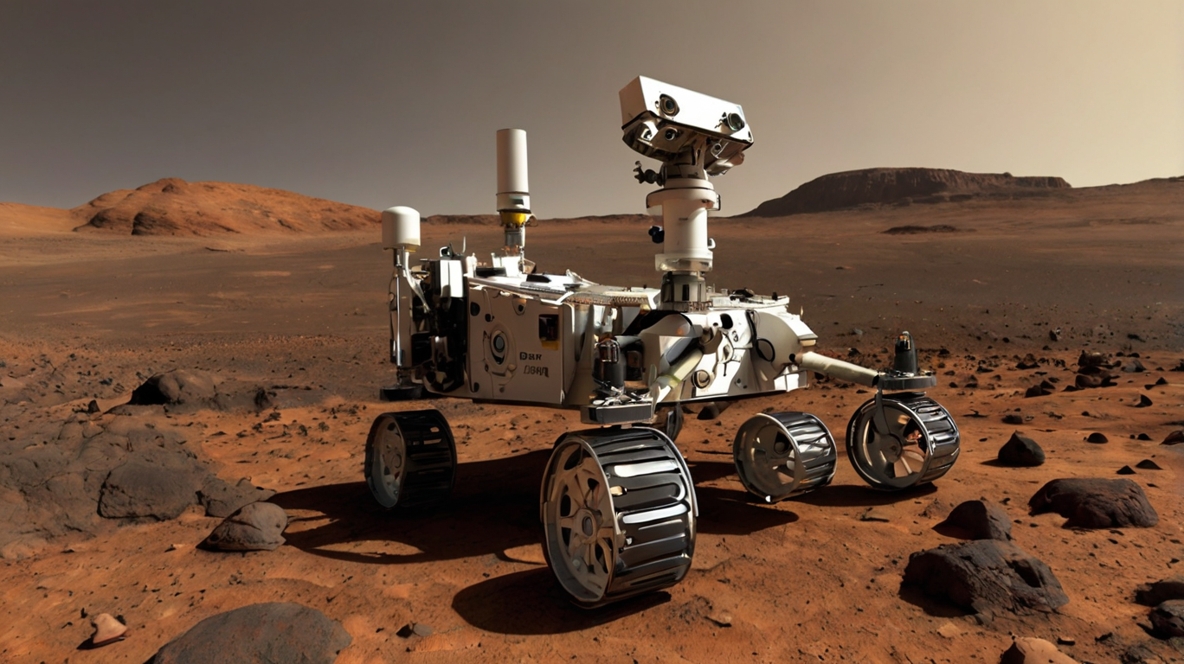
The Latest Discoveries from Mars has long fascinated scientists, dreamers, and space enthusiasts. As humanity’s next frontier for exploration, Mars holds the key to understanding more about our own planet, the solar system, and the potential for life beyond Earth. Thanks to NASA’s relentless efforts in planetary science and space exploration, our knowledge of the Red Planet has expanded dramatically in recent years. In this blog, we’ll delve into the latest discoveries from Mars, revealing new findings that could shape the future of space science.
1. Discovery of Ancient Organic Molecules
One of the most groundbreaking discoveries from Mars has been the detection of organic molecules in the planet’s surface soil. NASA’s Curiosity rover identified these molecules, which are essential building blocks of life, suggesting that Mars may have once had the conditions necessary to support microbial life. These findings fuel ongoing research into the planet’s ancient environments, potentially shifting the focus toward finding signs of past life.
Implications for Mars Exploration:
The presence of these organic molecules doesn’t confirm life on Mars, but it opens up the possibility that microbial life may have existed in the past. This discovery intensifies the quest for further exploration of Mars’s past environments.
2. Water Ice Deposits Below the Surface
Mars exploration missions, particularly NASA’s Mars Reconnaissance Orbiter, have detected vast reserves of water ice beneath the planet’s surface. These frozen reserves are not just confined to the polar regions but are spread across mid-latitudes, accessible in areas closer to the equator. This discovery is vital for future manned missions to Mars, as these ice deposits could be harvested for drinking water, oxygen, and even rocket fuel.
Future of Space Science and Human Exploration:
The presence of accessible water ice simplifies the logistics of sending astronauts to Mars. It reduces the need to carry massive amounts of water and increases the feasibility of long-term habitation on the planet.
3. Methane Spikes in Mars’ Atmosphere
NASA’s Curiosity rover also detected mysterious methane spikes in Mars’ atmosphere. Methane is a gas typically produced by biological processes on Earth, raising the exciting question of whether life—or some form of geological activity—might be producing it on Mars. These periodic spikes have baffled scientists, and further research is required to determine whether this methane is a product of living organisms or a geological process.
Planetary Science Significance:
The presence of methane on Mars offers a tantalizing hint that biological processes may be at work on the planet, either in the present or past. This makes it a key focus of ongoing planetary science research.
4. Marsquakes Detected by InSight
NASA’s InSight mission has been detecting seismic activity on Mars, commonly referred to as “Marsquakes.” These seismic events help scientists gain insights into the planet’s internal structure, including its core, mantle, and crust. Studying Marsquakes allows researchers to better understand the geological history of Mars and how it compares to Earth.
Advancing Planetary Exploration:
By measuring Marsquakes, planetary scientists can reconstruct Mars’ geological evolution, providing clues to its past tectonic activity and potential for future geophysical changes.
5. The Discovery of Ancient Riverbeds
NASA’s Perseverance rover has been exploring ancient riverbeds and lake deposits in the Jezero Crater, once home to a massive river delta. This is crucial as liquid water is considered a fundamental requirement for life. Evidence of these ancient water systems suggests that Mars had a much warmer and wetter climate billions of years ago.
Planetary Science and Climate Research:
The discovery of ancient riverbeds points to Mars’ wetter past, contributing to our understanding of planetary climate change and hydrology. It provides context for how planets can evolve from potentially habitable environments to the harsh, dry conditions we see on Mars today.
6. Perseverance’s Oxygen Generation Experiment
One of the most exciting advancements in Mars exploration comes from the Perseverance rover’s MOXIE experiment. MOXIE (Mars Oxygen In-Situ Resource Utilization Experiment) successfully generated oxygen from Mars’ carbon-dioxide-rich atmosphere. This technology could be a game-changer for future human missions, providing breathable air and fuel for rockets.
Implications for Future Mars Missions:
The success of MOXIE demonstrates that Mars has the potential to support human life by utilizing its natural resources. This breakthrough could reduce the cost and complexity of future missions by allowing astronauts to produce oxygen on-site, rather than bringing it from Earth.